Getting everyone rowing in the same direction: The overlooked job of leadership
Reading time: 4 min.
It sounds almost too simple.
Yet in business coaching and executive coaching, I keep seeing variations of the same problem: capable people working hard, but not necessarily working in the same direction.
It may show up as slow decisions, duplicated effort, internal friction, missed handoffs, competing priorities or departments protecting their own interests. The symptoms differ. But often, underneath them is a lack of alignment.
And alignment does not happen by itself. Creating it is one of the fundamental jobs of leadership.
Alignment is more than communicating the strategy
Organizations put considerable effort into defining strategy, setting goals and communicating priorities. That matters. But communication alone does not create alignment.
Research from MIT Sloan illustrates the gap. In an analysis of 124 organizations, only 28% of executives and middle managers responsible for strategy execution could list three of their organization’s strategic priorities.
If the people responsible for execution cannot clearly identify what matters most, it becomes difficult to expect the rest of the organization to make consistently aligned decisions.
But strategic clarity is only part of the equation.
Functions have different priorities, incentives, timelines and pressures. Oxford professor Jonathan Trevor has highlighted how leaders are often accountable for optimizing their own areas while nobody is sufficiently focused on whether all the pieces work together as an enterprise.
That is where silos become expensive.
Managers have to create alignment in three directions
Every manager sits at the intersection of three forms of alignment.
Upward
Does the manager clearly understand what their leader expects, what the organization is trying to accomplish and how their function contributes?
Assumptions create gaps quickly. A manager may be executing well against yesterday’s priorities while senior leadership has already shifted focus.
Across
Is the manager aligned with peers on shared priorities, dependencies, trade-offs and responsibilities?
This is where organizations can lose enormous amounts of time. Each department can be performing well according to its own measures while the business as a whole struggles.
Sales can optimize for volume while operations struggles with capacity. Finance can protect costs while another function needs investment to deliver a strategic priority.
Each function may have a rational argument. Alignment means resolving those tensions around what is best for the organization.
Downward
Does the team understand what matters, why it matters, what is expected and how its work contributes?
Gallup has reported that only 44% of employees strongly agreed that they could see how their work goals connected to their organization’s overall goals. Its research also emphasizes the role managers play in creating that connection.
That is not simply an HR responsibility. It is the role of management.
A manager who manages tasks but does not continuously create alignment upward, across and downward is only doing part of the job.
Alignment does not mean agreement
A well-aligned leadership team is not a group of people who always agree.
Patrick Lencioni makes this point powerfully in The Five Dysfunctions of a Team. Healthy teams build trust, engage in productive conflict, commit to decisions, hold one another accountable and focus on collective results.
The sequence matters.
Leaders need room to challenge assumptions, argue different perspectives and surface competing interests. But once a direction is established, they need to commit to it and align their teams behind it.
Alignment is not conformity. It is coordinated commitment.
Misalignment has an operating cost
Alignment should not be treated as a soft leadership concept.
Misalignment creates rework because people acted on different assumptions. Decisions take longer because stakeholders were not aligned early enough. Meetings multiply because priorities keep being renegotiated. Teams protect resources. Managers escalate issues that should have been resolved between peers.
Employees expend significant energy navigating internal complexity instead of creating value for customers.
The problem is not necessarily that people are not working hard enough. They may be rowing very hard in slightly different directions.
Turn alignment into a management discipline
In The Advantage, Lencioni provides a practical blueprint for organizational health built around four disciplines: build a cohesive leadership team, create clarity, overcommunicate that clarity and reinforce it through the organization’s systems.
People need to understand why the organization exists, how it intends to succeed, what matters most right now and who is responsible for what. Leaders then need to repeat and reinforce that clarity until it shapes everyday decisions.
A quarterly strategic rhythm can make this practical. Establish the few priorities that matter most for the next period, translate them into departmental commitments and bring leaders back together regularly to resolve dependencies and adjust execution.
The goal is not more planning. It is greater alignment around execution.
Culture reinforces the same discipline. Values should clarify the behaviours expected when priorities collide: collaboration, accountability, transparency, constructive disagreement and focus on collective results.
High performance is coordinated performance
Organizations naturally drift out of alignment.
Priorities change. New people arrive. Functions develop their own pressures. Growth adds complexity. Urgent issues compete with strategic ones.
That is why alignment cannot be an annual exercise. It is an ongoing leadership discipline.
Leaders create clarity. Managers connect that clarity across the organization. Teams translate it into coordinated action.
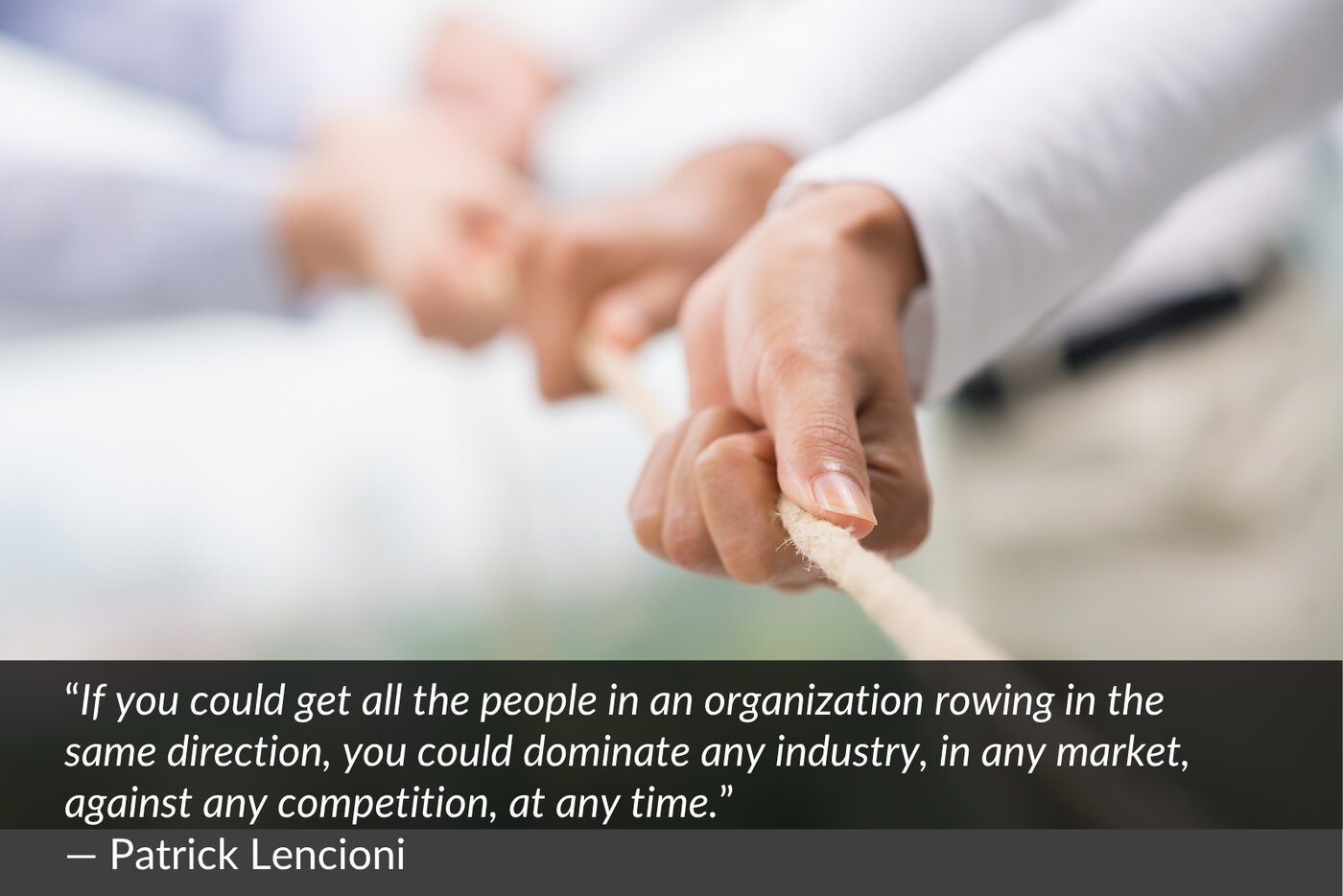
Lencioni’s rowing metaphor is powerful because organizational performance is not simply the sum of individual effort.
The real advantage comes when that effort is aligned.